Model Year Guide
2027 Hyundai Kona: Trims, MPG, Release Date and Pricing for New York Drivers
Published | Updated | Plaza Hyundai, Nostrand Avenue, Brooklyn, NY
In this city, a subcompact SUV is not a compromise. It is the right size. The 2027 Hyundai Kona is a little over 171 inches long and roughly 62.5 inches tall, so it takes curb spots a midsize crossover drives past, and it clears the ceiling limits posted in older garages.
The honest headline for 2027: Hyundai did not redesign the Kona. It carries over from 2026 with a change list you can read in one breath. That is not a knock. The 2026 model year was the reset, when Hyundai cut the ladder to four trims and rebuilt the middle of the range. The 2027 keeps that structure, the standard 12.3-inch touchscreen, available all-wheel drive on every trim, and the warranty that convinces a lot of city buyers to hold a car for a decade.
The short version
- Carryover year on the second-generation Kona introduced for 2024, with two small equipment changes.
- Four trims: SE, SEL Sport, SEL Premium, Limited.
- Two engines: a 147-hp 2.0-liter and a 190-hp 1.6-liter turbo.
- HTRAC all-wheel drive available across the range.
- Already arriving, with volume building through fall 2026.
- Awards: IIHS Top Safety Pick+ and a Kelley Blue Book Best Buy in the subcompact SUV class.
What's changing on the 2027 Kona?
Very little, and Hyundai has been direct about it. The 2027 Kona is listed internally as a carry-over model, and the official change list from 2026 contains exactly two items.
First, Idle Stop and Go is dropped from the SE trim. That is the system that shuts the engine off at a red light. Some drivers liked it for the fuel savings in traffic; plenty of others switched it off every morning because of the restart shudder. If you are the second type, the base 2027 Kona just got quieter at a light on Ocean Parkway.
Second, ambient interior lighting moves up the ladder. For 2026 it was on SEL Premium and above. For 2027 it is Limited only, which changes which trim you shop if you actually use it. Everything else carries forward: both engines, the four-trim structure, the 12.3-inch touchscreen, wireless Apple CarPlay and Android Auto, and the Hyundai SmartSense driver assistance suite.


When is the 2027 Kona release date?
The 2027 Kona is already in production and already reaching dealers. Because it is a carryover rather than a redesign, there was no show reveal and no long wait. Units started landing during summer 2026, and supply builds through the fall as the 2026 model sells down. That means a mixed lot for a few months, with leftover 2026 cars sitting next to the first 2027s, often on different incentive programs. That overlap is usually the best window for a buyer.
The Kona Electric is scheduled to return for 2027
The all-electric Kona skipped 2026 in the United States entirely. Hyundai paused production to sell through 2025 stock and confirmed assembly would resume as a 2027 model. Industry reporting points to a narrower relaunch, likely opening in the base SE configuration with the smaller battery rather than the full trim spread it once offered. Range has not been published, so treat that as a plan rather than a promise.
A full redesign is coming, but probably not as a 2027
Worth knowing before you sign anything: industry reports say Hyundai is skipping the usual mid-cycle facelift and going straight to a complete redesign, reportedly codenamed SX3. Uncamouflaged prototypes point to a bigger, boxier vehicle drawing on the rugged Crater concept, with a new infotainment system inside. Most reporting expects it to reach the United States as a 2028 model.
What that means for you: the current Kona is available now and stays available through the 2027 model year. If you specifically want the redesigned one, expect a wait of roughly a year or more, a higher launch price, and thin early inventory. A late-cycle model year is usually the better value, not the worse one.


Will the 2027 Kona cost more?
Only modestly, based on published figures. The SE opens at roughly $25,500 before destination, near $27,150 once freight is added. The Limited sits around $32,650 before destination, close to $34,185 delivered. That is about a $7,000 walk from bottom to top, narrow for a segment where the spread often passes $10,000. Hyundai has not announced a broad increase tied to the model year, which fits a carryover with no redesign cost to pass along. HTRAC adds roughly $1,500 and is offered on all four trims.
Two things move the real number more than MSRP: the incentive program running that month, and whether you lease or finance. Current offers are on our Plaza Hyundai specials page, and factory programs are under Hyundai incentives.
2027 Hyundai Kona trims compared
| Trim | Engine | Power | Starting MSRP | What defines it |
|---|---|---|---|---|
| SE | 2.0L, CVT | 147 hp / 132 lb-ft | About $25,500 | 12.3-inch touchscreen, wireless CarPlay and Android Auto, Hyundai SmartSense, 17-inch wheels. Idle Stop and Go deleted for 2027. |
| SEL Sport | 2.0L, CVT | 147 hp / 132 lb-ft | Roughly $28,000 | Sportier exterior treatment, upgraded wheels, added convenience equipment. Same efficient engine. |
| SEL Premium | 1.6L turbo, 8-speed auto | 190 hp / 195 lb-ft | Roughly $30,500 | Turbo engine starts here, plus 19-inch alloys, H-Tex seating, power driver's seat with lumbar. Ambient lighting moves to Limited for 2027. |
| Limited | 1.6L turbo, 8-speed auto | 190 hp / 195 lb-ft | About $32,650 | Surround View Monitor, Blind-Spot View Monitor, hands-free smart liftgate, Bose premium audio, ambient lighting. |
Which one makes sense here? If your week is mostly surface streets and one bridge or tunnel, the SE or SEL Sport is plenty. The 2.0-liter is not fast, but in traffic averaging under twenty miles an hour, horsepower is the least useful thing you can buy. If you deal with real highway merging, the Belt, the Cross Bronx, or regular runs up the Hudson Valley, the 1.6 turbo is worth the walk to SEL Premium; the extra 43 hp and 63 lb-ft show up exactly where a short on-ramp needs them. The Limited earns its price on visibility hardware, and with double-parked box trucks and cyclists in the door zone, Surround View and Blind-Spot View are not luxury items.
How does the 2027 compare with the 2026, and what did the last restyle change?
Against the 2026, the differences are the two already covered. Pricing, powertrains, dimensions, screens and safety equipment carry over, so a leftover 2026 with the right color and a stronger incentive costs you nothing meaningful.
The 2026 model year was the consequential one. Hyundai cut four trims and introduced SEL Sport and SEL Premium, which is why the current ladder looks nothing like the 2024 brochure. The base engine also gained output, moving up to 147 horsepower.
The last true restyle was the full 2024 redesign, and it was substantial. Hyundai lengthened the wheelbase, squared off the liftgate and moved to the K3 platform. Cargo room behind the rear seats grew by more than six cubic feet and maximum volume by nearly eighteen. The cabin was rebuilt around a floating panel with dual 12.3-inch displays, a column-mounted shifter that freed up console space, and a rear seat that fits adults without negotiation. Every 2024 through 2027 Kona sits on that architecture, which is why a well-kept used one shops so closely against a new one.

Engines, MPG and what all-wheel drive really costs
Two four-cylinders, and the choice is straightforward. The 2.0-liter makes 147 hp and 132 lb-ft through a CVT and is the efficiency pick. The 1.6-liter turbo makes 190 hp and 195 lb-ft through a conventional eight-speed automatic, and it is the one you want above 45 mph.
| Configuration | City | Highway | Combined |
|---|---|---|---|
| 2.0L front-wheel drive | Up to 28 | Up to 35 | About 31 |
| 2.0L HTRAC all-wheel drive | 26 | 29 | 27 |
| 1.6L turbo front-wheel drive | 26 | 32 | 28 |
| 1.6L turbo HTRAC all-wheel drive | 24 | 29 | 26 |
All-wheel drive costs roughly six highway MPG against the best front-drive number. That is the honest trade, and for many drivers here it is worth paying. An unplowed side street in Flushing or Bay Ridge, a wet ramp onto the Grand Central, a February block that nobody salted: HTRAC does not turn the Kona into a truck, but it takes the drama out of pulling away from a light on a slick surface. If the car sleeps in a garage and rarely sees snow, front-wheel drive with good all-season tires is cheaper and thriftier.


Why the Kona works as a New York vehicle
The competitive case here is not about lap times. It is about the handful of things that decide whether owning a car in this city is pleasant or exhausting.
It parks, and it fits under the ceiling. At just over 171 inches, the Kona is shorter than a Camry, which is the difference between taking a spot and driving past it. At roughly 62.5 inches tall it clears the height limits posted at most older garages, which routinely cut off larger SUVs. If you rent a monthly spot, measure the sign before you buy anything. The available Surround View Monitor turns a tight parallel park between a delivery van and a hydrant into a one-attempt job.
It carries more than it looks like it should. There are 25.5 cubic feet behind the rear seats and up to 63.7 with the 60/40 bench folded, plus a dual-level cargo floor. That covers a full cart from Costco, a flat-pack run, or a stroller plus a week of groceries. The low load height matters more than the raw number when you are lifting a case of water out on a sloped street. Rear legroom is 38.2 inches, which is genuinely usable for adults on an airport run, and the H-Tex seating on the upper trims wipes clean after a rainy commute.
It is cheap to feed and cheap to keep. Around 31 MPG combined with the 2.0-liter is real money where fuel sits above the national average, and Hyundai's 10-year, 100,000-mile powertrain warranty plus 5-year, 60,000-mile basic coverage matters where cars take a beating from potholes, road salt and curb rash. Complimentary maintenance runs the first three years or 36,000 miles.
One more thing New Yorkers ask about. Without a driveway, service is the real friction of ownership here, not the car. Our service department offers pick-up and drop-off across the NYC metro area, so the Kona gets its oil change while you are at work instead of costing you a Saturday. On the buying side, we deliver purchased vehicles free within 25 miles, covering most of Brooklyn, Queens, Staten Island, lower Manhattan and a good stretch of Nassau County.


Awards and safety credentials
The Kona has a strong run of recognition behind it. The 2026 model earned Top Safety Pick+ from the IIHS, the organization's highest award, with Good ratings across the crash tests conducted and for its standard vehicle-to-pedestrian front crash prevention. The IIHS also flagged it as the least expensive SUV on that year's Top Safety Pick list. Kelley Blue Book named the 2026 Kona a Best Buy in the subcompact SUV class, and Car and Driver has placed it on the Editors' Choice list for subcompact SUVs. NHTSA rates it four stars overall, with five in the side crash test. At the brand level, U.S. News & World Report named Hyundai Best SUV Brand, and Hyundai Motor Group collected sixteen IIHS Top Safety awards for the 2026 calendar year.
Hyundai SmartSense is standard on every trim, including forward collision avoidance assist with pedestrian and cyclist detection, lane keeping assist, and driver attention warning. Junction turning detection is worth calling out on its own, since unprotected left turns across traffic are one of the more common ways a city fender bender happens.


How the Kona stacks up against its rivals
The class is crowded: Kia Seltos, Nissan Kicks, Subaru Crosstrek, Honda HR-V, Toyota Corolla Cross, Chevrolet Trax, Volkswagen Taos, Mazda CX-30. The Seltos undercuts the Kona at the entry point. The Crosstrek makes all-wheel drive standard. The Kona's argument is the combination of a 12.3-inch screen at the base price, an available turbo that is genuinely quick, the Top Safety Pick+ result, and the warranty.
Cross-shopping is easy here because Plaza Auto Mall runs five new-vehicle franchises on one campus. If a 2027 Kia Seltos or a Honda HR-V is on your list, you can drive all three back to back the same afternoon. Inside the Hyundai lineup, the 2027 Tucson and Tucson Hybrid is the size up and the 2027 Elantra is the sedan alternative.
Shopping the 2027 Kona at Plaza Hyundai
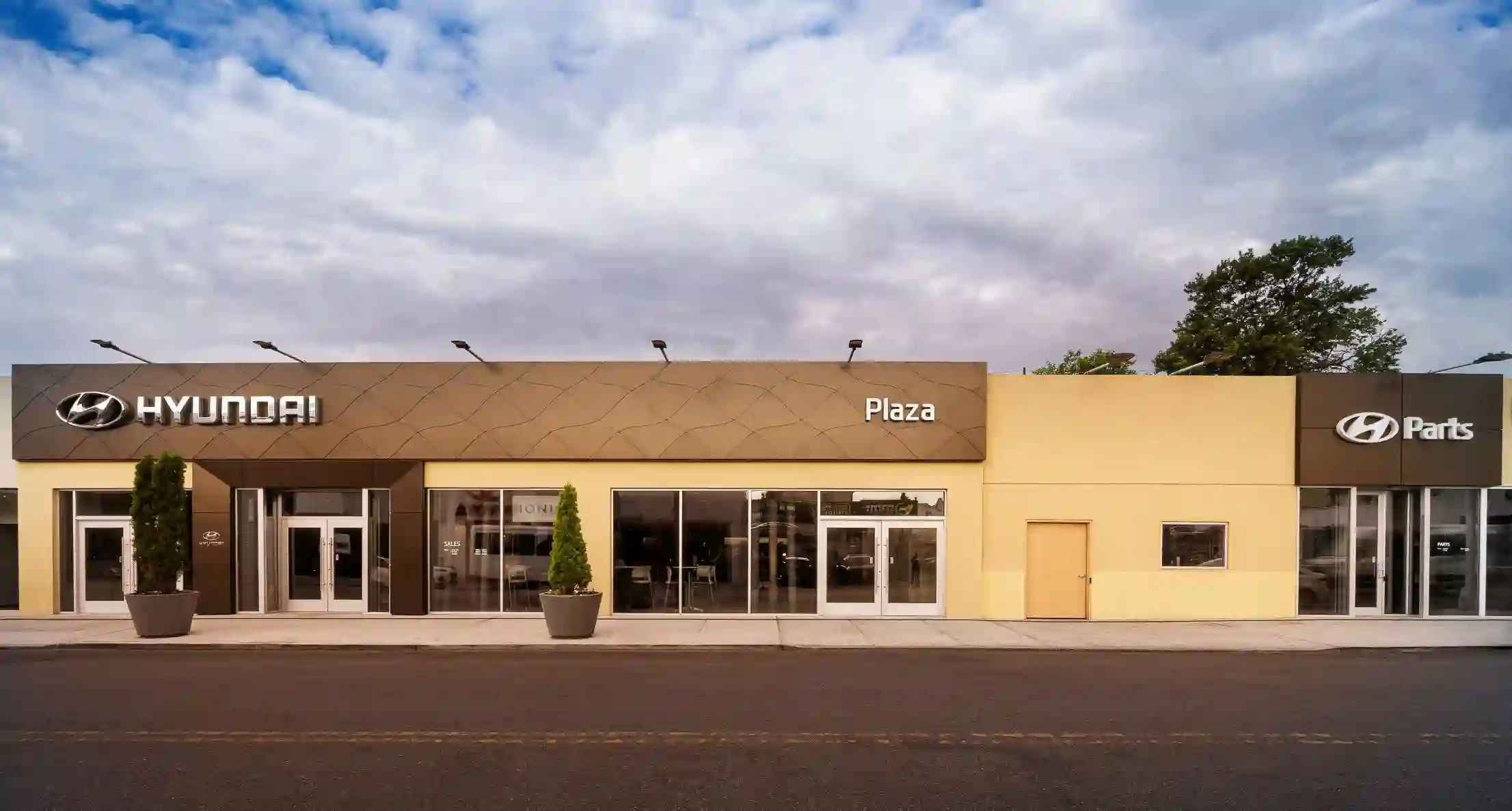
Plaza Hyundai sits on Nostrand Avenue as part of Plaza Auto Mall, a family-owned group selling and servicing cars in this city since 1975. The campus holds over 1,000 vehicles in stock, and every rooftop is within a seven-minute walk of the next. If the Kona is on your list next to something from another brand, you compare them on one visit instead of driving across three boroughs.
Financing questions get answered before you commit. Pre-approval takes a few minutes and does not require a Social Security number or date of birth to start, so you can see where you stand without handing over anything sensitive up front.
We speak your language
- English
- Spanish
- Russian
- Ukrainian
- Georgian
- Arabic
- French
- Urdu
- Punjabi
- Bengali
- Uzbek
- Tajik
- Turkish
- Haitian Creole
- Polish
- and beyond
Built around how New Yorkers actually live
- Service pick-up and drop-off across the NYC metro area.
- Free delivery of purchased vehicles within 25 miles.
- Five new-car brands plus certified pre-owned and a full multibrand used inventory on one campus.
- Collision work handled through Plaza Body Shop.
Plaza Auto Mall. No Hassle, No Pressure, No Middlemen.
Other ways to shop
Not every Kona shopper ends up in a new Kona. A certified pre-owned Hyundai with two years on it covers the same ground for meaningfully less, since the platform has not changed since 2024. Certified vehicles go through a factory inspection and carry extended coverage; the details are on our certified pre-owned process page. Others come in to trade first and shop second, which is fine too. We buy cars outright whether or not you buy one from us.
Cross-brand shopping at Plaza Auto Mall
Five new-vehicle brands and one multibrand used inventory, all within a short walk of each other on Nostrand Avenue.


2027 Hyundai Kona: frequently asked questions
What is actually different about the 2027 Kona compared with the 2026?
Two things. Idle Stop and Go, the engine stop-start system, is removed from the base SE trim. And ambient interior lighting, included on SEL Premium and above for 2026, is now Limited only. Engines, trims, pricing structure, screens, dimensions and safety equipment carry over unchanged.
When can I buy a 2027 Kona in New York?
Now. As a carryover model year rather than a redesign, 2027 units began arriving during summer 2026 with volume building through the fall. Leftover 2026 Konas often sit on the same lot for a while carrying different incentive programs, which is a good moment to compare the two.
Will the 2027 Kona cost more than the 2026?
Not by much. The SE starts around $25,500 before destination, roughly $27,150 delivered; the Limited runs about $32,650 before destination, near $34,185 delivered. Hyundai has not announced a broad increase tied to the model year. Your monthly payment moves more with incentives and term than with MSRP.
Is the Kona Electric coming back for 2027?
That is the plan. The electric Kona skipped the 2026 model year in the United States while Hyundai sold through 2025 stock, and Hyundai confirmed production would resume as a 2027 model. Industry reporting suggests a narrower relaunch, likely starting with the base SE configuration and the smaller battery. Final specification and range have not been published.
Does the 2027 Kona come with all-wheel drive?
Front-wheel drive is standard. HTRAC all-wheel drive is available on all four trims rather than restricted to the expensive ones, generally around $1,500. It costs roughly six highway MPG, the trade for better traction on wet ramps and unplowed side streets.
What gas mileage does the 2027 Kona get in city driving?
With the 2.0-liter and front-wheel drive, the EPA estimate reaches 28 city and 35 highway, roughly 31 combined. All-wheel drive brings that to about 26 city and 29 highway. The 1.6 turbo rates around 26 city and 32 highway front-drive, 24 and 29 with HTRAC. Real-world numbers in dense stop-and-go traffic land below the city figure on any car.
How big is the Kona, and will it fit in a city parking garage?
It is a little over 171 inches long and roughly 62.5 inches tall, shorter than most compact sedans and low enough to clear the height limits posted at most older garages. Cargo space is 25.5 cubic feet behind the rear seats, up to 63.7 with the second row folded. If you rent a monthly spot, check the posted clearance sign before buying anything.
Should I wait for the redesigned Kona instead?
Depends on your timeline. Industry reports say Hyundai is skipping the mid-cycle facelift and going straight to an all-new Kona, expected to be bigger and boxier with a new infotainment system, most likely arriving here as a 2028 model. That means a wait of roughly a year or more, a higher launch price and limited early supply. If you need a vehicle in the next few months, the 2027 is the better financial answer.
Does Plaza Hyundai have 2027 Konas in stock?
Inventory changes daily as allocation arrives. The live list is on our Kona inventory page. If the trim, drivetrain or color you want is not showing, tell us the exact combination and we will look across the group. Naming the trim, whether you want HTRAC, and an acceptable color range gets an answer in one search instead of three.
Do you deliver, and what languages does the team speak?
We deliver purchased vehicles free within 25 miles, reaching most of Brooklyn, Queens, Staten Island, lower Manhattan and much of Nassau County, and service pick-up and drop-off runs across the NYC metro area. Our team speaks English, Spanish, Russian, Ukrainian, Georgian, Arabic, French, Urdu, Punjabi, Bengali, Uzbek, Tajik, Turkish, Haitian Creole, Polish and more, so you can handle the whole transaction in the language you negotiate best in.
What is Plaza Auto Mall?
Plaza Auto Mall is the family-owned group Plaza Hyundai belongs to, operating on Nostrand Avenue in Brooklyn since 1975. It carries five new-vehicle brands, Hyundai, Toyota, Honda, Kia and Acura, with certified pre-owned inventory for each, plus a body shop. More than 1,000 vehicles sit on the campus, and every showroom is within a seven-minute walk of the others.
Where can I see used vehicles from every brand in one place?
The full multibrand used inventory is at plazaautomall.com/used-inventory. That listing pulls pre-owned vehicles from all of the rooftops together, which is the fastest way to compare a used Kona against a used HR-V, Seltos, Corolla Cross or RDX.